
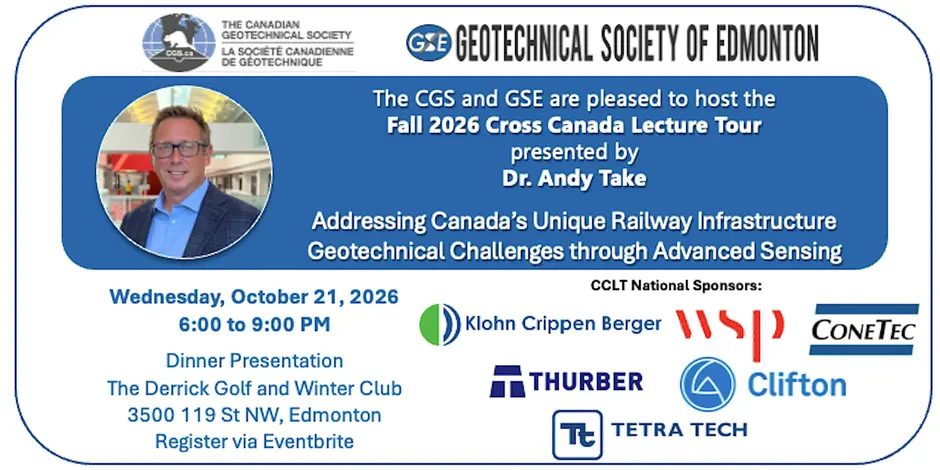
The Geotechnical Society of Edmonton is pleased to present the Canadian Geotechnical Society Cross-Canada Lecture Tour featuring Dr. Andy Take
Date: October 21, 2026
Time: 6:00pm – 9:00pm
Location: The Derrick Golf and Winter Club, 3500 – 119 Street NW
Cost: Students $15, CGS/GSE Members $30, Non-members $40
Click to register for in-person attendance on EventBrite
Registration @ 6:00pm; Dinner @ 6:30pm; Presentation @ 7:30pm
Abstract
With more than 46,000 kilometres of track, Canada’s railway network faces nearly every geotechnical challenge imaginable, including geohazards, soft soil subgrades, highly compressible peat, and underlying permafrost. Through a geologically informed route selection process, geotechnical challenges for new rail lines such as the Alto high speed rail project can be minimized. However, for Canada’s existing railway corridors defined more than a century ago, avoidance of geotechnical challenges is no longer possible and track issues must be addressed while minimizing service interruption. While different fixes for various geotechnical subgrade issues have been proposed, the railway geotechnics community is lacking quantitative performance data on their effectiveness. This is in large part due to the highly structurally redundant and complex nature of track support, and in many sites, the lack of stable benchmarks. In this lecture, we explore how advanced sensing techniques of high-speed imaging, distributed fiber optic strain sensing, ShapeArray sensors, and data mining of track geometry vehicle data can be combined to capture both the dynamic behaviour of track support (i.e. passage of a single train) and rates of long-term degradation. We then use this technology to quantitatively define the effectiveness of helical piles placed between sleepers as rigid inclusions to improve trackbed stiffness; rammed aggregate piers placed between sleepers to arrest settlement trough formation; and to quantify the rates of localized settlement due to permafrost thaw on the Hudson’s Bay Railroad. These observations are then used to draw overarching lessons learned from each case study with regards to both railway monitoring and subgrade rehabilitation.
Bio
Dr. Andy Take is Professor in Geotechnical Engineering at Queen’s University and Co-Editor-in-Chief of the Canadian Geotechnical Journal. Andy completed his undergraduate and masters degree at the University of New Brunswick before obtaining a PhD at Cambridge University in 2004. For the past 22 years, Andy’s team at Queen’s has combined advanced sensing and physical modelling to explore topics of infrastructure climate change resilience, failure mechanisms of landslides and tailings dams, and to advance infrastructure field monitoring techniques. The work of Andy and his team of graduate students has resulted in over 200 publications and has been recognized with major international awards including the RM Quigley Award and Fredlund Award of the Canadian Geotechnical Journal, the Casimir Gzowski Medal of the Canadian Society for Civil Engineering, the Tso Kung Hsieh Award of the UK’s Institution of Civil Engineers, the International Geosynthetics Society Award of the International Geosynthetics Society, and the Edward B. Burwell Jr. Award of the Environmental and Engineering Geology Division of the Geological Society of America.